

With 37 million in lockdown and Covid plans under fire, Chinese ask: what comes next?
When nearby neighbourhoods went into lockdown, Liu Li started stocking up. The 42-year-old Chinese magazine worker bought vegetables, fruit, medicine and other supplies, adding to stores of basics she had maintained since the pandemic began. Last Sunday a resident in the community where Liu lives with her mother, in Changchun city, Jilin, tested positive. Everyone was ordered inside.
The fresh lockdown has, so far, been OK. “I live a normal life,” she says. “I work when there are tasks for me. If there aren’t any, I talk to my mother, watch TV, or play with my cat.”
Liu is luckier than some – she works from home and was well prepared. But there is also a risk. Her mother is a cancer patient and unvaccinated. They are now among the 37 million people under lockdown in China, as authorities battle the country’s biggest outbreak of the pandemic.
China has successfully contained every one of its outbreaks before this one, through a resource-heavy response, including mass testing, transport shutdowns, and localised lockdowns. But this time Omicron, the milder but much more virulent Covid-19 variant sweeping the world, has challenged the old strategies.
On Friday, China reported 4,130 confirmed and asymptomatic cases across more than 20 provinces, including 2,626 in Jilin province. On Saturday, the country’s first two Covid deaths in over a year were recorded in the region. Forecasters at Lanzhou University have predicted 35,000 people will contract the virus if it is not contained by early April.
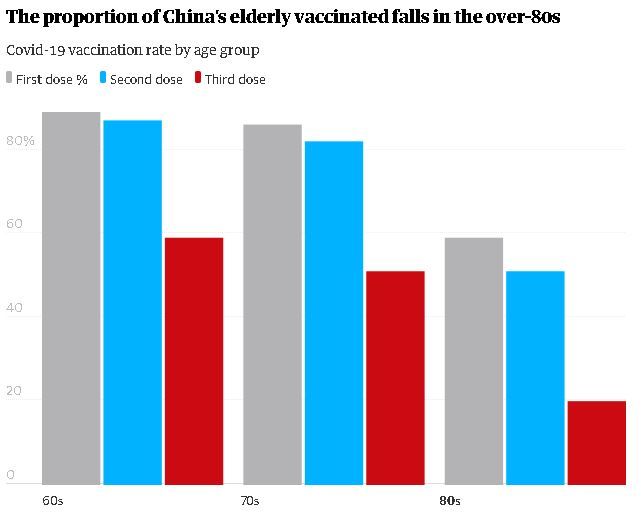
State media says 95% of cases are mild, but of acute concern is an estimated 17 million people aged over 80 – around half of the age group – are still not fully vaccinated, according to an analysis of vaccine and population data. Just 19.7% have had a booster, health authorities said on Friday. They are among about 52 million people over the age of 60 (19%) who have not been vaccinated.
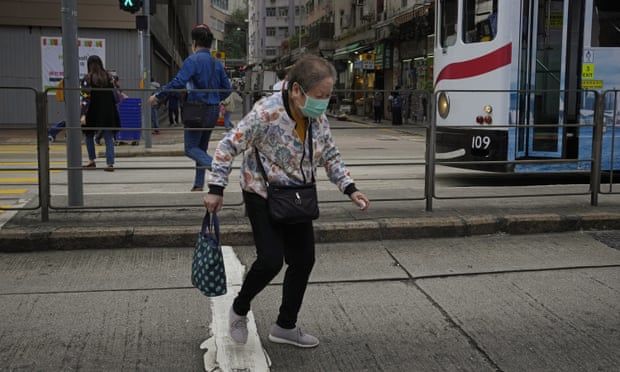 A woman in Hong Kong last week. Low vaccination rates among this vulnerable demographic have recently emerged.
Unlike in many other countries where health professionals have almost uniformly encouraged vaccination, in China many of those who haven’t been jabbed say they are following their doctor’s advice.
“Because she is a cancer patient and has undergone two operations, she cannot be vaccinated,” Liu says. “The doctor suggested that it should be decided according to our physical condition and living environment.”
One citizen on Weibo, the Chinese social media network, said: “My mother has a lot of syndromes, so she can’t be vaccinated. We have been to the hospital three times and they wouldn’t vaccinate her, so we gave up.”
Fear of adverse reactions is a common reason among unvaccinated elderly people. “My father- and mother-in-law have high blood pressure, so they didn’t dare to be vaccinated,” said another citizen on Weibo.
Instead, Liu has taken other precautions to protect her mother. Before the latest lockdown she didn’t go out much but, when she did, she avoided crowds and wore a mask. “As long as I pay more attention in daily life, things will be fine.”
Low vaccination rates among this vulnerable demographic have also emerged in Hong Kong – where unvaccinated elderly people are disproportionately among the sick and the dead – and Taiwan, which is rushing to convince its residents to get the jab before it has an outbreak.
Professor Chi Chun-huei, director of the centre for global health at Oregon University, calls the hesitancy the “paradox of the zero-Covid policy”. “When there was an extended period without any domestic outbreak, the risk of infection was close to zero,” he told the Observer. “When people in China assess the benefit versus risks of Covid vaccination, the perceived benefit is nearly zero, while the perceived risks [of side effects and complications] are relatively high.”
A November 2021 study of China’s vaccine hesitancy also listed price as a top three concern, despite the government announcing in January 2021 that it would be free. “Either free vaccination was not completely universal, or the free programme was not well-communicated to the public,” says Chi.
Some residents have grown weary with the life interruptions brought by the “dynamic zero” policy of dealing with outbreaks. On Friday, footage went viral of PPE-clad workers fighting with residents in a Chinese car park. Online, people sniped about Shenzhen, Shanghai, and Hong Kong “dragging down” other provinces with less restrictive responses.
The government remains committed to “dynamic zero”, but there are signs of concern that the cost is becoming intolerably high. Last week Goldman Sachs estimated a month-long lockdown of 30% of China could see GDP drop by one percentage point.
At a closed-door meeting of the politburo standing committee on Thursday, China’s leader, Xi Jinping, appeared to acknowledge the toll of the policies when he demanded China strive for “the maximum prevention and control at the least cost, and minimise the impact of the epidemic on economic and social development”.
It’s easier said than done. There are signs that authorities recognised this outbreak was different. For the first time, China approved the use of at-home rapid antigen tests, and added the use of antiviral pills made by Pfizer to pandemic guidelines. It also declared an end to mandatory hospitalisation of all Covid patients, and will send asymptomatic and mild cases to centralised isolation facilities.
In the tech hub of Shenzhen, Apple supplier Foxconn was among businesses which went back into operation just a few days into the citywide lockdown, enacting a “closed loop” system similar to that which ran during the Beijing Winter Olympics, to minimise economic disruption.
But Chi says they are unlikely to abandon “dynamic zero” any time soon. Dozens of local officials have been fired or punished over the outbreak. The Hong Kong government has drawn the ire of Beijing for its mishandling of an Omicron outbreak which health authorities estimate has already infected about half the population. “The CCP’s political legitimacy hinges on its capability to provide Chinese people with a stable and safe life, for which containing the Covid-19 infection is critical,” he says.
The outbreak has put China at a crossroads. If containment doesn’t work, the caseload among a population of 1.4 billion people will be huge, and analysts predict major disruptions to the economy and global supply chain.
If containment works, it prompts the question: what next? “Zero-Covid” strategies rely on closed or heavily restricted borders and travel, and Covid is in the world for the foreseeable future. When does China reopen?
Professor Antoine Flahault, director of the institute of global health at the University of Geneva, says Omicron means “dynamic zero” is no longer an effective or sustainable option, citing the economic impact of lockdowns which also feel increasingly disproportionate to people who experience mild Covid-19.
Chi expects China to contain the outbreak, but he suggests continuing spread in a well-prepared setting may not be the worst thing, as recent studies have said natural immunity gives stronger protection than vaccines. “Omicron with high contagiousness and low severity/fatality is a good candidate to achieve this strong population immunity,” says Chi.
For now, Liu is comfortable in her lockdown, but suggests she sees a future envisioned by Flahault. She is confident China will prevail over the outbreak, through the current measures and with greater immunity and improved treatment options. “I’m not worried, on the contrary I think things will get better.”