

Paraguay looks for change as election looms. But that’s not on the ballot
Paraguay is bracing for what is expected to be one of the most fiercely contested general elections in the country’s short democratic history, with a vote which may see the ruling rightwing Colorado party defeated after more than 75 years of almost uninterrupted power.
The Colorado stranglehold on power has loosened in an election run-up marked by cries for change, pressure from the US, and the rise of a populist “anti-system” candidate known for punching and defecating his way through disputes.
“There’s an enormous difference with this year’s elections and it has to do with financial resources,” said political scientist Rocío Duarte.
For more than a decade the Colorado party has been bankrolled by the enormous wealth of former president Horacio Cartes, who remains the party president and the political patron of its current candidate, Santiago Peña.
But in January, he was targeted with US sanctions for “rampant corruption that undermines democratic institutions” and alleged links to Hezbollah, starving the Colorado electoral machine of funding and access to bank loans.
The current financial blow, along with deep internal party conflicts, has seen Peña fall in the polls to a statistical tie with third-time hopeful Efraín Alegre. Rightwinger Alegre is a candidate for the Coalition for a New Paraguay, a confederation of opposition parties that includes his own Liberal party, the country’s second-biggest political force.
“I’m optimistic that the opposition can win, but I’m very deeply pessimistic about what the Coalition [for a New Paraguay] will be able to do if it’s actually in government,” said political scientist Gustavo Setrini, pointing to a lack of coherent policy proposals from coalition leaders in response to enormous inequality, recession and rising extreme poverty rates.
“The two candidates are different flavours of clientelist neoliberalism. One is more linked to narcotrafficking and authoritarianism, and the other to the Liberal party and nominally more progressive elites,” he said.
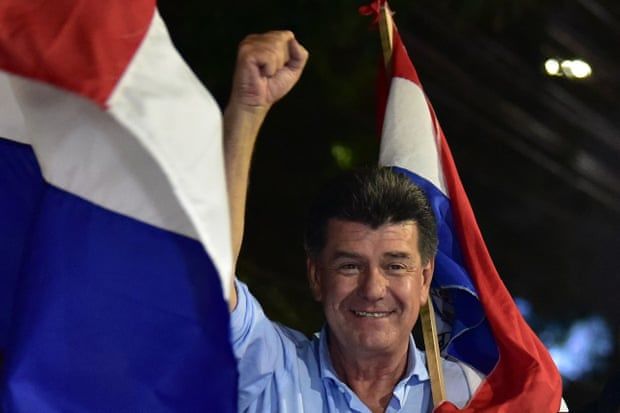 Efraín Alegre, the Coalition for a New Paraguay candidate for the Paraguayan presidency, during a campaign rally on Monday.
Both Peña and Alegre have pledged not to raise taxes, despite Paraguay having an underfunded state and the lowest tax burden in South America, which greatly benefits society’s wealthiest.
One key difference between the candidates is their position on Paraguay’s diplomatic relationship with Taiwan: Paraguay is the largest of 13 countries to still recognise the island.
Alegre said he would consider switching recognition to China over Taiwan, in line with Beijing’s one-China principle, stating that Paraguay “loses many opportunities” that were not sufficiently rewarded by Taiwan.
“It would be a historic mistake for Paraguay,” said Carlos Fleitas, Paraguay’s ambassador to Taiwan, adding that Taipei is closely observing the elections following Honduras’s recent break with the island.
“The relationship with Taiwan isn’t only economic,” he said. “We share the same values of freedom and justice.”
On the street, however, the relationship with Taiwan “isn’t of importance for voters”, said Duarte. In contrast, she said that widespread discontent with state institutions and traditional parties had fed the rapid rise of the “anti-system” candidate Paraguayo “Payo” Cubas, a candidate who has drawn comparisons to Brazil’s far-right former president Jair Bolsonaro and El Salvador’s authoritarian leader Nayib Bukele.
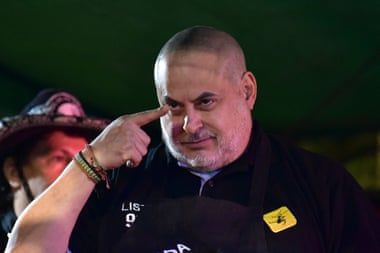 Paraguayo ‘Payo’ Cubas at a rally in San Lorenzo, Paraguay, at the weekend.
Cubas, a former senator who was expelled from Congress and is notorious for physical altercations and defecating in a judge’s office, has employed social media to run a bare-bones campaign. He has said he will instate the death penalty and spoke in favour of establishing a dictatorship, and he is currently polling in third at 23%.
“Payo is the only one who can tear it all down,” said Alejandro Daniel, an Uber driver in the Paraguayan capital, Asunción.
Duarte described Cubas as a belated example of the populist trend which swept across Latin America and the world in the past decade. “Everything reaches Paraguay a few years later, so now we’re seeing this anti-system current here,” she said.
Despite palpable disillusionment with traditional parties, many insist that a non-Colorado government is an essential step forward for Paraguay, where democracy was only introduced in 1989 following the 35-year rightwing dictatorship of Gen Alfredo Stroessner, of which the Colorado party itself was an integral part.
The National Campesino Federation (FNC), a powerful peasant farmer organisation, has taken sides in electoral politics for the first time, backing Alegre and the Coalition for a New Paraguay.
“The coalition offers us a respite. The other option is a continuation of the same politics without healthcare, without education, without land, without work, without productive policies for campesinos,” said the FNC leader Teodolina Villalba.
Alegre, should he win, could also face Colorado majorities in both houses of congress, also disputed on 30 April. And to implement any major changes, he would first have to avoid the fate of former president Fernando Lugo, the only non-Colorado president since democratisation began in 1989.
Leftist Lugo was impeached in 2012 by a hostile congress – including then senator Alegre – in what many analysts saw as a coup that truncated a promising process of deep transformation.
For Setrini, an Alegre administration would hold a position of enormous historic responsibility for ensuring progress in Paraguay’s tortuous process of democratisation.
“Interrupting Cartes’s model of the state is positive,” he said. “But the risk is that if you sell the Coalition [for a New Paraguay] as a change, but it’s totally unworkable as a government, you’re going to end up making people even more sour on democracy.”