PanamaTimes

Sunday, Oct 25, 2026

Planet Earth: 8 billion humans and dwindling resources

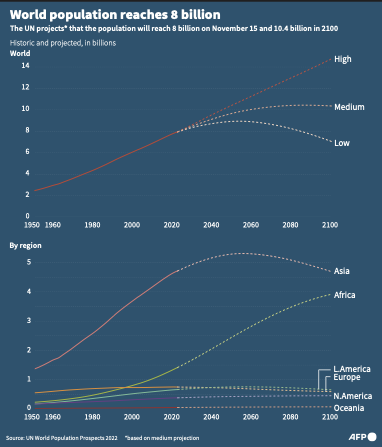
Are eight billion humans too many for planet Earth? As we reach this milestone on November 15, most experts say the bigger problem is the over-consumption of resources by the wealthiest residents.

“Eight billion people, it is a momentous milestone for humanity,” said United Nations Population Fund chief Natalia Kanem, hailing an increase in life expectancy and fewer maternal and child deaths.

“Yet, I realize this moment might not be celebrated by all. Some express concerns that our world is overpopulated. I am here to say clearly that the sheer number of human lives is not a cause for fear.”

So, are there too many of us for Earth to sustain?


Many experts say that this is the wrong question. Instead of the fear of overpopulation, we should focus on the over-consumption of the planet’s resources by the wealthiest among us.

“Too many for whom, too many for what? If you ask me, am I too many? I don’t think so,” Joel Cohen of Rockefeller University’s Laboratory of Populations told AFP.

He said the question of how many people Earth can support has two sides: natural limits and human choices.

'We are stupid and greedy'

Our choices result in humans consuming far more biological resources, such as forests and land, than the planet can regenerate each year.

The overconsumption of fossil fuels, for example, leads to more carbon dioxide emissions, responsible for global warming.

We would need the biocapacity of 1.75 Earths to sustainably meet the needs of the current population, according to the Global Footprint Network and WWF NGOs.

The most recent UN climate report mentions population growth as one of the main drivers of an increase in greenhouse gases. However, it plays a smaller role than economic growth.

“We are stupid. We lacked foresight. We are greedy. We don’t use the information we have. That’s where the choices and the problems lie,” said Cohen.
However, he rejects the idea that humans are a curse on the planet, saying people should be given better choices.

“Our impact on the planet is driven far more by our behavior than by our numbers,” said Jennifer Sciubba, a researcher at the Wilson Center, a think tank.

“It’s lazy and damaging to keep going back to overpopulation,” she added, as this allows people in wealthy nations, who consume the most, to cast the blame for the planet’s woes onto developing countries where population growth is highest.

“Really, it’s us. It’s me and you, the air conditioning I enjoy, the pool I have outside, and the meat I eat at night that causes so much more damage.”

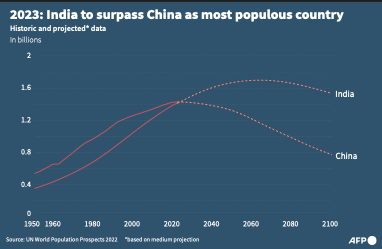
If everyone on the planet lived like a citizen of India, we would only need the capacity of 0.8 Earths a year, according to the Global Footprint Network and WWF. If we all consumed like a resident of the United States, we would need five Earths a year.

The United Nations estimates that our planet will be home to 9.7 billion people by 2050.

Protecting women's rights


One of the trickiest questions that arise when discussing population is that of controlling fertility. Even those who believe we need to lower the Earth’s population are adamant about protecting women’s rights.

Robin Maynard, the executive director of the NGO Population Matters, says there needs to be a decrease in the population, but “only through positive, voluntary, rights-respecting means” and not “deplorable examples” of population control.

The NGO Project Drawdown lists education and family planning among the top 100 solutions to halt global warming.


“A smaller population with sustainable levels of consumption would reduce demands on energy, transportation, materials, food, and natural systems.”

Vanessa Perez of the World Resources Institute agrees that “every person that is born on the planet puts additional stress on the planet.”

“It is a very thorny issue,” she said, adding that we should reject “this idea that the elite capture this narrative and say we need to cap population growth in the South.”

She believes the most interesting debate is not about the number of people but “distribution and equity.”

Cohen points out that even if we currently produce enough food for 8 billion people, there are still 800 million people who are “chronically undernourished.”

“The concept of ‘too many’ avoids the much more difficult problem, which is: are we using what we know to make the human beings we have as healthy, productive, happy, peaceful, and prosperous as we could?“

Newsletter

Related Articles

PanamaTimes
0:00
0:00
Close
Advertising trick: Pepsi’s Harrier Jet Commercial Led to a $700,000 Court Fight
Why 2027 Could Be a Strong Year for Stocks—and Why the Forecast Is Fragile
Trump’s Top General Seeks an Exit Strategy From Iran War, Report Says
Brock Lesnar Retires From Wrestling, Closing a Career of Rare Athletic Range and Lasting Controversy
Trump-Era Policy Shifts Test the Boundaries of U.S. Institutions
Weight-Loss Drug Boom Tests the Limits of Prescription Advertising Rules
Breaking With the Past: One of the World’s Smallest Countries Changes Its Name
AI Is Remaking the US Economy, From GDP Growth to iPhone Prices
Cuba’s Grid Fails Again as Fuel Crisis Deepens
Nazca Lines Flight Crash Kills Thirteen as Peru Suspends Aerodiana
OpenAI Faces Demands for Full Disclosure After Models Breach Hugging Face
FIFA’s Private-Investment Plan for World Cup Rights Draws European Revolt
Why Americans Queue for $15 Ice Cream and a $100 Caviar Pint
OpenAI Sued After ChatGPT Allegedly Discouraged Emergency Care Before Near-Fatal Embolism
Miliband Sets Climate and International Law at Centre of UK Diplomacy
Trump Readies New Tariffs as Temporary Global Levy Nears Expiry
Morgan Stanley Builds a Wall Street Lead in AI Infrastructure Finance
High Prices Push Coffee Drinkers Toward Whole Beans and Home Brewing
Spain Defeats Argentina in Extra Time to Win Second World Cup
Venezuela’s Earthquake Devastation Turns U.S. Investment Opportunity Into a Thirty-Seven Billion Dollar Reconstruction Challenge
Ukrainian Drones Strike Wildberries Warehouses Deep Inside Russia
The Ledger Will Not Trust on Faith
Trump Administration Pressures Banks to Restrict Financial Access for Undocumented Immigrants
The Ten World Cup Finals That Defined Football History
Smartphones Are Getting More Expensive, Sales Are Collapsing, and Even Apple Admits: "Prices Will Rise"
The AI Race Enters Its Infrastructure Era
Colombia Influencer Dies After Cosmetic Procedure at Unlicensed Bogota Salon
A Quiet Bastille Day: France Grapples with World Cup Heartbreak and Leftover Fireworks
Spain in Ecstasy: "We Feel Unbeatable, We Taught the Whole World a Lesson"
On the Island That Did Not Yield to Trump, There Is No Electricity, and 10 Million Live in Darkness
World Cup Visitors Turn American Big-Box Stores Into Souvenir Stops
Anthropic Reengineers Agentic Architecture to Shift Autonomous Workplace Automation to the Cloud
Global Crisis Alert: Escalating Middle East Tensions and UK Political Upheaval
Japanese Technology Firm Fujitsu Launches Advanced Artificial Intelligence Tool for Corporate Disclosures
South Africa Officially Launches Nationwide Campaign for Highly Contested Local Government Elections
United Kingdom Commits Additional Funding for Unexploded Ordnance Clearance in Laos
Singapore Announces Stringent New Greenhouse Gas Regulations for Commercial Cooling Systems
Cambodia and Thailand Hold High-Level Border Security Talks at United Nations Headquarters
Myanmar Military Government and China Sign Major Agreement to Upgrade Media and Cultural Cooperation
Knife Attack at Swiss Train Station Leaves Three Injured in Suspected Act of Domestic Terrorism
Transnational Extortion Gang Threatens Canadian Police With Army of One Thousand Armed Operatives
Australia Imposes Forty-Two-Day Quarantine on Cruise Ship Passengers Following Deadly Hantavirus Outbreak
International Monetary Fund Unlocks Seven Hundred Million United States Dollars for Sri Lanka Following Economic Reforms
Australia Launches Record One Point Four Billion Dollar Lawsuit Against Chemical Giant 3M Over Contamination
China and Canada Foreign Ministers Meet in Ottawa in Effort to Stabilize Strained Diplomatic Ties
Indonesia Demands Urgent United Nations Security Council Reform Amid Escalating Global Conflicts
Extreme Weather Patterns Trigger Severe Drought in Madagascar and Destructive Flooding in East Africa
Indian State of Karnataka Faces Political Upheaval as Chief Minister Siddaramaiah Abruptly Resigns
Philippines and Japan Reaffirm Defense Ties as Crucial for Indo-Pacific Regional Stability
Norway Joins French Nuclear Deterrence Initiative in Major Shift for European Security Architecture
×