

‘We want no more hatred’: leftwing ex-president Lula on verge of comeback in Brazil
Brazil’s leftwing former president Luiz Inácio Lula da Silva appeared on the verge of a startling political comeback on Sunday as more than 156 million Brazilians took part in the country’s most important election in decades.
As the veteran ex-president cast his vote in Brazil’s industrial heartlands on Sunday morning, Lula voiced optimism he was heading for victory over the far-right incumbent Jair Bolsonaro.
“We want no more hatred, no more quarrelling, we want a country that lives in peace,” the 76-year-old told reporters in São Bernardo do Campo, the city where he began his legendary political career as a unionist in the 1970s.
Polls on the eve of the election suggested Lula – who governed from 2003 to 2010 – was tantalisingly close to securing the overall majority of votes he needs to avoid a second-round runoff against Bolsonaro in late October.
But by late on Sunday the election appeared to be heading for a run-off on October 30, as Bolsonaro’s strong initial showing seemed to have ended Lula’s hopes of a first-round victory.
With 70% of votes counted, Lula was ahead with 45.74% compared to Bolsonaro’s 45.51% – although those numbers were expected to change as votes from traditionally pro-Lula regions were tallied.
A Lula victory would represent the latest in a series of triumphs for a resurgent Latin American left, following the election of leftist leaders in Argentina, Bolivia, Colombia and Chile.
“I’m going to win these elections so I can give the people the right to be happy again. The people need, deserve and have the right … to be happy once more,” Lula told journalists as he wrapped up his campaigning with a parade through the streets of São Paulo on Saturday.
The prospect of a Lula victory has galvanised leftwing and centrist Brazilians after four years under Bolsonaro during which nearly 700,000 people died of Covid and more than 30 million were plunged into poverty and hunger.
“I feel hope,” the former president’s biographer and friend Fernando Morais told the Guardian as he prepared to vote wearing a Jeremy Corbyn T-shirt. “I feel like going out and distributing kisses.”
Morais considered Lula’s return to power the only way to tackle the intensifying “social tragedy” that was on full show as the writer drove to the polling station in downtown São Paulo.
“When you go out at night around here … only 1km from the homes of bankers and big businessmen, you see people freezing to death,” Morais said as he turned into a square where dozens of emaciated people had taken shelter under filthy blankets and in tents. A giant banner hung over the square by anti-Bolsonaro activists read: “Brazil has gotten worse”.
“This didn’t exist 10 years ago … It’s like an improvised refugee camp,” Morais said.
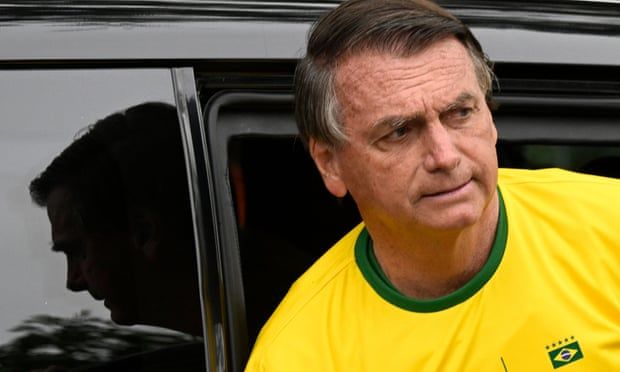 Brazilian president and re-election candidate Jair Bolsonaro arrives at a polling station to vote in Rio de Janeiro.
Across town near São Paulo’s main avenue, Paulista, Lula supporters flocked to polling stations in T-shirts bearing his name and the star symbol of the Workers’ party (PT) he helped found four decades ago.
“Today is a day of hope,” said Eduardo Horderle Peruzzo, a 35-year-old University of São Paulo historian. “We know that this election won’t fix everything. We know this is the beginning of a long path. But we want Brazil to at least be able to dream of the future again.”
“So many of the advances that took decades to achieve have been destroyed over the last four years,” said his partner, music teacher Mariana Moga de Moura Silva.
Bolsonaro, a Donald Trump-admiring former army captain, was defiant as he cast his vote in a military neighbourhood on the outskirts of Rio, where he built his political career. “I’m confident from what I’m seeing,” the 67-year-old populist told reporters.
But polls suggest more than half of Brazilians now reject Bolsonaro, on whose watch Amazon deforestation has soared to record levels and Brazil has become an international outcast.
“I think the end is nigh in the sense that I truly believe Bolsonaro will not win this election,” said Flávia Oliveira, a political commentator from the television channel GloboNews.
“Everything in the polls suggests the majority of Brazilian voters no longer support this project, as they did in 2018. This project has lost adhesion and has lost allies precisely because it has failed to improve people’s lives.”
Bolsonaro’s authoritarian inclinations
and relentless questioning of Brazil’s electronic voting system have fuelled concerns he may refuse to accept defeat to Lula. Some fear he may seek to incite turmoil similar to the 6 January invasion of the Capitol in the US if his re-election bid fails, or even a military coup.
Trump backed Bolsonaro on the eve of Sunday’s vote with a video message to Brazilians. “He’s done an absolutely incredible job,” Trump claimed, calling Bolsonaro “one of the great presidents of any country in the world”.
“I have met many leaders but few as exceptional as President Bolsonaro,” Hungary’s far-right prime minister, Viktor Orbán, said in a video shared on social media by the Brazilian president.
Those declarations further fuelled progressive angst over how Bolsonaro and his radical supporters could behave in the coming hours and days.
Asked if he would respect the result of Sunday’s election, Bolsonaro turned his back on reporters and walked away.